
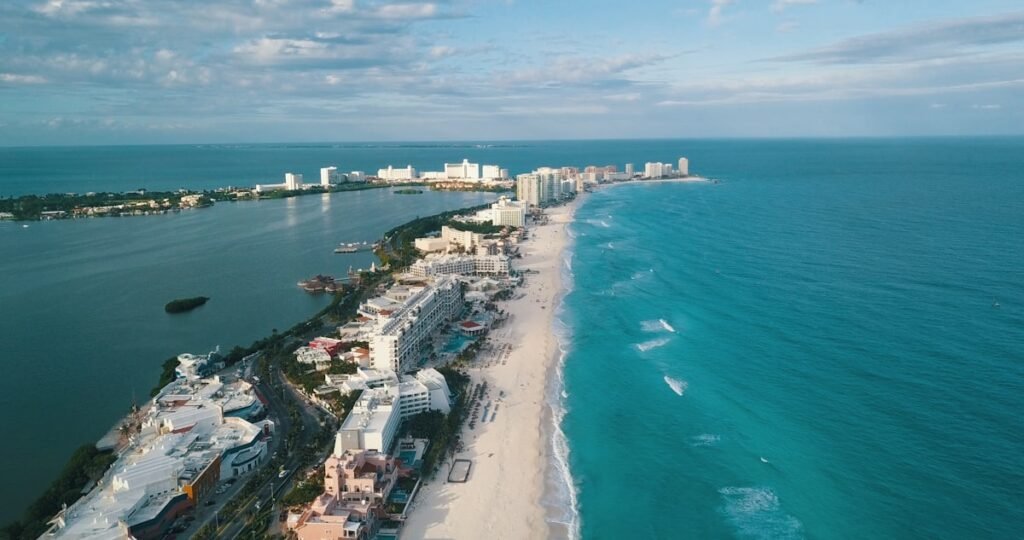
Every winter, tens of thousands of Canadians land at Cancun International (CUN) for the first time, most having decided on autopilot where to sleep. Cancun and Playa del Carmen share an airport, a coastline and a currency, but they are genuinely different trips. One is a purpose-built resort strip. The other is a walkable beach town about an hour down the highway. Picking the wrong one is the most common first-timer regret, so let’s sort that out first, then cover flights, paperwork, money and activity bookings.
Key takeaways
- Cancun’s Hotel Zone is a resort strip 20 to 30 minutes from the airport, while Playa del Carmen is a walkable beach town 45 to 60 minutes away.
- 22 Canadian airports have direct flights to Cancun, and realistic round trips from Toronto or Montreal run $350 to $650 CAD in shoulder season.
- Canadians need no visa, Cancun’s airport no longer issues paper FMM cards, and the Visitax of about 283 pesos (roughly $21 CAD) should be paid only at visitax.gob.mx.
- December through April is the dry, clear-beach window; the 2026 sargassum season could rival the worst on record, with the heaviest landings June through August.
- Ride-hail apps are not permitted to pick up at CUN airport; the reliable options are the ADO bus at about 270 pesos, a pre-booked transfer or official taxis.
Cancun vs Playa del Carmen: two different trips
Cancun’s Hotel Zone (Zona Hotelera) is a 22 kilometre sandbar lined with high-rise resorts, most of them all-inclusive. The beaches are the best in the region: wide, white, and facing open Caribbean water. The trade-off is that almost nothing is walkable; leaving the resort means a taxi or bus along the boulevard. Nightlife is big, loud and concentrated near kilometre 9. Downtown Cancun (El Centro) has cheaper food and hotels but no beach.
Playa del Carmen is a town. You stay in a hotel or condo a few blocks from the sand, walk to dinner on Quinta Avenida (Fifth Avenue), and never need a car. The beach is narrower and the surf calmer, with Cozumel sitting on the horizon. The vibe is more European backpacker-turned-digital-nomad than spring break. Nightlife exists but skews bars and beach clubs rather than mega-clubs. Prices for food and mid-range rooms generally run lower than the Hotel Zone. The catch is distance: Playa is roughly 45 to 60 minutes from CUN by highway, so you are adding a transfer each way.
| Cancun (Hotel Zone) | Playa del Carmen | |
|---|---|---|
| Setting | Resort strip on a sandbar | Walkable beach town |
| Beaches | Wide, dramatic, open ocean | Narrower, calmer water |
| Best for | All-inclusive ease, big nightlife | Independent travel, food, day trips |
| Walkability | Low, taxis and buses | High, most of it on foot |
| Nightlife | Mega-clubs, resort bars | Bars, beach clubs, live music |
| Typical cost | Higher, resort pricing | Lower to mid, more variety |
| From CUN airport | 20 to 30 minutes | 45 to 60 minutes |
| Day-trip base | Fine, but farther from Tulum | Excellent, central to everything |
A rule of thumb that holds up well: if the beach and the resort are the vacation, pick Cancun. If the vacation is cenotes, ruins, ferries and tacos, and the room is just where you sleep, pick Playa.
Getting there from Canada
Cancun is one of the easiest sun destinations to reach nonstop from Canada. As of August 2026, 22 airports across Canada have direct flights to CUN. Toronto alone has around 35 nonstops a week spread across Air Canada, WestJet, Air Transat, Flair and Porter. Montreal, Ottawa, Calgary, Edmonton and Vancouver all have year-round or winter nonstop service, and Air Canada is adding a Calgary to Cancun nonstop this December as part of its winter 2026-27 expansion.
On price, this is a high-competition route, which is good news. As of August 2026, Kayak shows Canada to Cancun round trips from about $411 CAD and Air Canada advertises fares from $289 CAD on sale. Treat those as the floor. Realistic round trips from Toronto or Montreal land between $350 and $650 CAD in shoulder season, and $550 to $900 CAD for peak winter weeks. From Calgary or Vancouver, add roughly $150 to $300. Christmas, New Year and March break are the expensive weeks; if your dates are flexible, we track the drops on our deals page and you can watch the Toronto route specifically on our YYZ to CUN route tracker.
Timing matters more here than on most routes. High season runs December through April: dry, warm, and reliably sargassum-free in the early months. Hurricane season officially runs June through November, with the statistical peak in September and October; direct hits are rare but travel insurance with weather coverage is cheap peace of mind. The other seasonal factor is sargassum, the brown seaweed that piles up on Caribbean beaches. The 2026 season has been a heavy one, with the University of South Florida’s monitoring lab warning that 2026 could rival the worst season on record and the heaviest landings typically running June through August, with December through February the most reliably clear months. If pristine sand is the whole point of your trip, book winter, not July.
Paperwork, pesos and other things to sort before you fly
Canadians do not need a visa for tourist stays in Mexico. The old paper FMM tourist card has also largely disappeared at this airport: as of 2026, CUN no longer issues paper FMMs, and your entry is recorded digitally with a passport stamp or an e-gate receipt showing how many days you were granted. Check the stamp before you walk away, since officers no longer grant 180 days automatically.
Quintana Roo also charges a state tourist tax called Visitax, about 283 pesos per person as of 2026, roughly $21 CAD. Pay it only at the official state site, visitax.gob.mx. Search results are crowded with lookalike third-party sites charging double or triple in “service fees.” Same tax, same QR code, worse price.
Money: pesos win. Cards are widely accepted at hotels and larger restaurants, but taxis, market stalls, tips and small cenotes run on cash. US dollars are accepted in tourist zones at rounded-down exchange rates that quietly cost you 10 to 15 percent. Withdraw pesos from a bank-branded ATM (not the freestanding ones in convenience stores), and always choose to be charged in pesos when a terminal offers you the CAD conversion. Tipping runs 10 to 15 percent in restaurants, 20 to 50 pesos for bellhops and housekeeping, and something for tour guides. Do not drink the tap water; every hotel provides purified water.
On safety: the Government of Canada advises travellers to exercise a high degree of caution in Mexico due to criminal activity, but Quintana Roo is not among the states under the stricter regional “avoid non-essential travel” advisories as of August 2026. The practical version: the tourist corridor is heavily policed and millions of Canadians visit without incident, but petty theft happens, so use the room safe, stick to well-lit areas at night, and skip anything involving drugs entirely.
Getting around once you land
Skip the rental car unless you are chasing remote cenotes. The ADO first-class bus runs directly from CUN’s terminals to downtown Playa del Carmen for about 270 pesos, roughly $20 CAD, as of 2026, comfortable and air conditioned. Between Playa and Cancun, white colectivo vans run constantly for under 100 pesos.
Uber is the asterisk. The app works in downtown Cancun and the Hotel Zone, but airport pickups remain a mess: despite a 2024 court ruling, federal authorities maintain that ride-hail apps are not permitted to pick up at CUN, and drivers avoid it because of taxi-union friction. As of August 2026, the reliable airport options are the ADO bus, a pre-booked private transfer, or official airport taxis. Agree on taxi fares before getting in anywhere; meters are not a thing here.
Booking cenotes, ruins and parks without getting burned
Your first test comes 10 minutes after landing. The corridor between customs and the curb at CUN is lined with polite people holding clipboards offering “free transfers” and “tourist information.” They are timeshare salespeople, and the free ride comes with a 90-minute presentation. Walk past everyone until you reach your pre-booked transfer or the ADO desk.
For activities, prices as of August 2026 look like this. Chichen Itza charges foreign adults 697 pesos, about $52 CAD, at the gate, payable in cash pesos; guided day tours from Playa or Cancun run $60 to $120 CAD with transport and lunch. Tulum’s clifftop ruins are cheaper to enter but now involve park shuttles, so budget a half day. The Cozumel ferry from Playa’s pier costs roughly 280 to 330 pesos one way, and the Isla Mujeres ferry from Cancun is comparable; both are walk-up easy, no tour needed. Cenotes charge their own entries, anywhere from 150 to 500 pesos depending on how Instagram-famous they are. Xcaret, the flagship eco-park, lists adult admission around $189 USD, with about 20 percent off for booking a week or more ahead on the official site.
The booking rule of thumb: use official sites for fixed-price attractions (ferries, Xcaret, park entries), use marketplaces like Viator or GetYourGuide for guided tours where free cancellation and reviews protect you, and treat street vendors as a last resort. The guys with laminated binders on Quinta Avenida sometimes have real deals, but you are trading away refunds, insurance and any recourse if the van never shows. Never pay a street vendor the full amount in cash up front, and never book anything sold inside the airport.
A simple five day first trip
Base yourself in Playa del Carmen for flexibility. Day 1: land, ADO bus to Playa, walk Quinta Avenida, tacos, sleep off the flight. Day 2: beach morning, afternoon ferry to Cozumel for snorkelling or a beach club, last ferry back. Day 3: early start to Chichen Itza on a guided tour, cenote swim on the return leg. Day 4: Tulum ruins first thing before the heat, then two or three cenotes along the highway. Day 5: slow morning, souvenir run, ADO back to CUN three hours before your flight. From a Cancun base, swap the Cozumel day for Isla Mujeres.
If you are the spontaneous type, CUN is one of the routes where last-minute seats genuinely appear, because so many airlines fly it. Either way, run your dates through our fare search before you pay the first price you see.
Deals we are seeing this week
The fares featured in this article have expired. Prices change every week. See today’s deals
FAQ
Is Playa del Carmen cheaper than Cancun? Generally yes, for food, drinks and mid-range hotels, because you compete with locals rather than resort pricing. All-inclusive packages muddy the comparison: a discounted Cancun all-in can beat a Playa trip where every meal is out of pocket. Price the whole trip, not the room.
Do Canadians need any documents besides a passport? A passport valid for the length of your stay, the digital entry record you get at immigration, and the Visitax payment (about 283 pesos as of 2026) before you fly home. No visa, no paper FMM at Cancun’s airport anymore.
When is the best time to go? December through April for dry weather and clear beaches, with January and February the sweet spot. May and November are decent value months. June through October is hot, humid, cheaper, and carries both hurricane-season risk and, in a year like 2026, heavy sargassum.